Showing posts with label cats. Show all posts

Monday, August 20, 2012

Why does my cat smell something, then open his/her mouth?


We cat owners have all seen it...you’re laying on the couch, minding your own business, when the cat jumps up and takes a big whiff of your feet. Your cat then opens its mouth and grimaces as if your feet are the worst smell it has ever encountered. Really makes you feel self conscious, doesn’t it?

A cat exhibiting the flehmen response.
Photo credit: fabcats.org
When this happens, you are seeing your cat’s Jacobson’s Organ (or vomeronasal organ, if you want to get fancy) in action. This organ is located on the roof of the mouth right behind the front teeth, and is connected to the nasal cavity. Many types of animals actually have this organ, even insects and reptiles. There are several theories about the use of the Jacobson’s Organ, but the most common theory is that the organ helps to sense pheromones and chemical compounds. Your cat accesses this organ through the “flehmen response”; this is where the cat opens its mouth and literally inhales the scent.

Cats generally utilize their Jacobson’s Organ when they encounter a scent that is unusual to them (like your sweaty feet.) Basically, your cat is trying to figure out what this scent means. Is it related to reproduction? Is it a scent marking? Is it food? The Jacobson’s Organ is not quite smelling, but it’s not quite tasting either. It’s a different sense altogether (one that science suggests humans lack.)

The Jacobson’s Organ is just another amazing way our cats become familiar with their surroundings, locate suitable sexual partners, and avoid danger. 

Tuesday, July 24, 2012

BANFIELD® PET HOSPITAL IS STAGING AN INFURVENTION

In Partnership with Animal Planet’s Victoria Stilwell, Banfield is Looking for Cats and their Owners in Need of Professional Help

Animal Planet's Victoria Stilwell
Photo Credit: petside.com
Portland, OR—July 18, 2012—Calling all cat owners: is a trip to the veterinarian a constant cat-fight? Do you sometimes find yourself avoiding routine visits to dodge a cat-tastrophe? Is “stressful” a term you use to describe the process of getting your cat out of the house and into the veterinarian’s office? If so, Banfield Pet Hospital and Animal Planet’s Victoria Stilwell want to hear from you.

Banfield Pet Hospital, the world’s largest veterinary practice, and Victoria Stilwell are staging an “inFURvention” to help combat pet owners’ difficulties of getting their cat into a carrier while raising awareness of the importance of regular veterinary visits for cats. Banfield and Stilwell are asking cat owners nationwide to upload videos of their real-life struggles and attempts to get their cat into a carrier for a chance to win a year’s worth of free preventive veterinary care and a special at-home visit and training consultation from Animal Planet’s famed pet trainer, Victoria Stilwell.

Of the 86 million felines living as pets in the U.S., an astonishing one-third of pet owners will skip a trip to the veterinarian to avoid the hassle* – yet missing a veterinarian visit could actually cause more harm to the pet. Cats rarely exhibit signs of sickness or disease even when a problem exists; therefore, routine veterinarian visits are essential to protecting pets from life-threatening illnesses.

“There is no doubt that cats can be finicky when it comes to travel; however, there are easy tips and tricks pet owners can use to ensure a smooth road ahead,” said Stilwell. “Pet owners don’t have to be a professional in order to train their cats to get into the carrier. All it takes is some practice and simple changes in behavior and cat-fights will soon be a thing of the past!”

It’s time for an “inFURvention!”

Beginning Wednesday, July 18 through Friday August, 17, pet owners are invited to upload their “real” cat videos to http://www.infurvention.com/, with the tag “#inFURvention” to be considered in need of an “inFURvention” from Stilwell. One pet owner and “inFURvention” video will be chosen to win a year’s worth of free preventive veterinary care from Banfield and a special at-home visit with Victoria Stilwell who will give professional insight into the best tips and tricks to getting your cat out of the house and into the veterinarian’s office.

“One of the biggest barriers to cats receiving veterinary care is actually getting them to the hospital,” said Dr. Jeffrey Klausner, chief medical officer for Banfield Pet Hospital. “Unfortunately, cats typically don’t show signs of illness until it is too late; therefore it is important for cats to receive twice-yearly veterinary visits in order to prevent, as well as diagnose and treat illnesses before it’s too late. Through ‘inFURvention,’ we hope to educate pet owners about the importance of routine veterinary visits, and let them know it doesn’t have to be a fight to get their cat to the vet.”

Tips and tricks to eliminating the cat-fight!

Basic training tips can ease cats’, as well as cat owners’ fears and hesitations when preparing for a trip to the veterinarian. Banfield’s medical team and Stilwell both recommend scheduling appointments later in the day for a quieter, calmer experience for felines. It is also important to remember that cats are sensitive to smells, so creating a pleasant environment in the carrier is key to helping cats cope with the trip, as well as including familiar objects such as a comfortable blanket to make felines feel more at home.

For a full list of tips and tricks to overcoming cat resistance, visit Banfield Pet Hospital online at www.banfield.com. Cat owners are welcome to submit a video for the “InFURvention” program at www.inFURvention.com with the tag “#InFURvention” beginning July 18 through August 17 for a chance at an at home visit with Animal Planet’s Victoria Stilwell.

About Banfield® Pet Hospital

Founded in Portland, Ore., in 1955, Banfield is the largest general veterinary practice in the world. In 2007, Banfield joined the Mars, Inc. family of businesses, and today we are more than 800 hospitals strong in neighborhoods across the United States. More than 2,600 veterinarians at Banfield are committed to giving pets the highest quality of veterinary care. Banfield hospitals offer a full range of comprehensive medical services, computerized medical records, preventive care plans for pets and extended operating hours. Banfield Pet Hospital helps extend the lives of millions of pets each year through Optimum Wellness Plans®. For journalists seeking more information, please visit our press room at http://www.banfield.com/ or contact our Media Hotline at 888-355-0595.

Monday, July 23, 2012

Why does my cat wag his/her tail?

When it comes to tail wags, cats and dogs are polar opposites! We all recognize a dog wagging his tail as a sign of happiness, and it’s easy to assume that the same would go for cats. WRONG. You know cats—nothing can ever be that simple!

This kitty is happy and confident.
Photo credit: petdental.com
Cats tell us a lot about how they’re feeling by their tail. This “tail language”, once deciphered, is a vital way your cat can communicate with you. For example, a tail raised high is a sign that a cat is happy and confident. A tail hanging low (and usually accompanying wide eyes and a crouching body posture) is a sign that a cat is nervous, scared, or in distress.

Sometimes you may notice that your cat is flicking the tip of his tail ever-so-slightly. This is generally a simple acknowledgment of stimuli in the room such as you talking to him. The cat is signaling that they’re still awake and aware of their surroundings.

When the tail begins to flick back and forth more noticeably, this is usually a warning sign from the cat that they are on-guard. You may see this behavior when the cat is a safe distance from a perceived threat (like young children), signaling “I know you’re there, and you probably shouldn’t come any closer.” It can also be seen during playtime or when your cat is watching the birds out the window, indicating the cat is on the hunt for prey. You may also notice heavier tail flicking when you’re petting your cat. At this point, your cat is politely letting you know that she is beginning to get a little irritated with you, so you may want to scale back a bit and give kitty some space.

A good old-fashioned kitty standoff
Photo credit: crazyauntpurl.com
If tail flicking escalates to tail wagging, your cat is trying to give you a very clear signal: “Knock it off, and get away from me!” The tail may whomp audibly back and forth. If your cat begins to rapidly wag its tail rapidly from the base while you are petting him, stop immediately. If you don’t, there is a high likelihood you’re about to get bit! You may see tail wagging accompanied with the cat flattening its ears onto its head; the cat is taking an aggressive stance. Never approach a cat displaying this posture, as they are likely to attack at the drop of a hat. If you see your cat displaying this posture towards another cat or pet, it is natural to want to step in between and “break it up.” Do this, and you may wish you hadn’t! Use something neutral like a pillow or towel to put between, if you absolutely must diffuse the situation. If two cats are posturing to each other in this manner, it’s usually just that…posturing. The posturing may be followed by a little paw boxing and growling, but frequently one cat will back down and walk away. In a multi-cat household, cats must constantly reinforce the feline hierarchy. Unfortunately, this means there are bound to be altercations now and again. It’s usually not necessary to break it up, but if a cat is at risk for injury you might have to.

Sometimes while your cat is being pet or just laying next to you, you may see her tail leisurely and slowly moving from side to side. This is a sign that your cat is relaxed and content. If the pace of the tail movement begins to pick up to a more irritated pace, back off. Cats are fickle creatures, and relaxed contentment can move to irritation fairly quickly. Get to know your cat’s tail signals, and you’ll be able to tell for certain when she’s had enough! Just like people, every cat has a unique personality and varying degrees of patience and tolerance. There is no “one size fits all” when it comes to how much petting is too much petting, or which areas of the body are off-limits for petting. Learning where your cat’s limits are and reading body language will go a long way in building a mutual respect and trust between you and your cat.  

See also: Why does my cat roll over, then bite me when I pet his/her belly?

Monday, July 16, 2012

Why does my cat roll over, then bite me when I pet his/her belly?

Welcome to Mad About Pets' 10-part series, "Why Does My Cat Do That?" We'll be addressing some common cat behaviors that can be confusing, frustrating, and even mysterious to owners. The first topic we'll be addressing today is "Why does my cat roll over, then bite me when I pet his/her belly?"

When a cat rolls onto its back, it is easy to mistake this for “Please pet my belly!” Unlike dogs, most cats do not like their tummy pet. As much as it would seem that way, a cat rolling on its back is not an open invitation for a belly rub!

In feline body language, a cat rolling onto its back is a sign of submission. The cat is basically saying to you “I am giving you the most vulnerable part of my body. See? I’m not a threat!” It can be a sign of trust, and also a sign that the cat views you as more dominant than him/her. The belly is, however, a very vulnerable area and most cats do not like it rubbed or petted. Petting the tummy can be easily misconstrued as threatening to the cat. You will often find that petting a kitty’s belly ends with the cat grabbing your arm with all four paws, bunny-kicking your forearm with his back claws and sinking his teeth into your hand. Mad About Pets likes to call this "The Tummy Rub Trap"!

Tempting though it may be, steer clear of the kitty tummy!
Common sense would tell us not to pet the cat’s stomach when it reacts so violently most of the time, but some people find this action “cute” and mistake it as playful behavior. If you continue to encourage the behavior, the cat will soon think of grabbing your arm and scratching/biting as a game. They will then try to goad you into petting their belly by laying on their back, and the behavior may eventually escalate into biting or scratching whenever a hand comes anywhere near them. This kind of play behavior is very hard to stop once it becomes a habit, and it can lead to accidental bites to friends and family members. Even with kittens where it doesn’t hurt as much, never ever encourage a cat to playfully bite! Cats have a really hard time telling when is and isn’t playtime, so you can’t expect your cat to know it’s ok to bite sometimes but not other times!

The best course of action when it comes to a cat showing his or her belly is to admire the cute softness, but keep hands clear. Unless you know the cat well and know that this particular animal truly enjoys belly rubs, it’s always safer not to risk it. There are those rare cats that truly enjoy having their tummies rubbed, kissed and nuzzled, but they are certainly not the norm. And even if they let their owner do it, they may not let anyone else. Err on the side of caution, and stick with chin scritches and head pets when meeting a new cat. Your hands and arms will thank you for it!

Monday, June 25, 2012

Interview: Specialty Purebred Cat Rescue seeking foster homes in the Midwest

When you think of “rescue cats”, what comes to mind? Probably a tabby cat, or perhaps an orange tomcat. It is true that the majority of cats in shelters and rescue are mixed breed, but once in a while a purebred cat will find itself without a forever home, too. That’s where Specialty Purebred Cat Rescue comes in!

Many of the cats at SPCR arrive neglected and in desperate
need of veterinary care
Many purebred cats do not adjust well in a shelter environment. Sensitive breeds like Siamese and Sphynx can become very ill, very quickly when placed in a stressful shelter situation. Purebred cats like Persians and Himalayans have rigorous grooming requirements, and often arrive with painful mats in their long coats. Specialty Purebred Cat Rescue takes in these special purebred cats, provides the proper veterinary care, and matches them up with new forever homes.

SPCR is an all volunteer group, and relies on the generosity of foster homes to provide shelter, care, socialization, and even nurse neglected or abused cats back to health. The number of purebred cats needing help is far greater than you might expect, and Purebred Cat Rescue is desperately seeking more foster homes.

Kirsten Kranz,  Rescue Director of Specialty Purebred Cat Rescue, was kind enough to grant Mad About Pets an interview outlining the need for foster homes within their organization. Please read on to learn more about this wonderful rescue group!

(Mad About Pets) Where do the cats in your rescue organization generally come from?

(SPCR) Our cats come from everywhere. They come from shelters all over the midwest that call us to take their cats. They come from owners who can no longer keep them. They come off the streets when people find them. It's pretty much never-ending.

Siamese cats are one of the common breeds SPCR takes in
What are the most common types of cats seen in your rescue?

We most commonly see Siamese, Persians, Himlayans and Ragdolls. These are the most common purebreds out there and the most being bred. We place more than 500 cats a year.

What exactly is a foster home, and what are foster parents expected to do?

A foster home provides a safe haven for these cats to de-stress, get better and receive any vet attention they need so they can move on to their Forever Homes. Our rescue is entirely foster-based so we rely on our foster homes to care for and evaluate these cats for placement. Foster parents are expected to provide a quiet, spare room and consistent care for the cats in their care. They need to be able to take them to one of our vets as needed, assess the cats' needs and personalities and work closely with us throughout the process. Cats are adopted by screened and pre-approved adopters from the foster parents' homes or from local Petsmart stores.

Why are foster homes so important to Purebred Cat Rescue?

We are entirely foster based. Without foster homes this rescue would not exist!

SPCR takes in rare and unusual breeds, too!
Are there certain areas/cities where you are in the most need of new foster homes right now?

The Madison and Milwaukee areas certainly need more foster homes as the need is very great. We could also use fosters in the Racine/Kenosha area.

How can Mad About Pets’ readers get more information about becoming a foster home for your organization?

Please go to our website at http://www.purebredcatrescue.org/fostering-info . We have a fostering information page there.

If you are interested in helping out Specialty Purebred Cat Rescue, there are many ways! First, please consider fostering. This is the most direct way you can help. If you’re looking for a new feline friend, you should also consider adoption from SPCR! There are constantly new cats listed on the website, and all of them are looking for a great new home.

If you’re unable to foster or adopt at this time, there are many other ways to assist SPCR on their mission. Check out this page to learn all about items the rescue needs to care for the cats, donating through iGive, and many more ways to help out!

Friday, June 22, 2012

Combating a Serious Flea Problem

Fleas are almost invisible due to their tiny size, but they can easily ride into your home on a sock or pants leg. Fleas cause obvious discomfort to your dog or cat and occasionally attempt to make a meal out of you and your family! Ctenocephalides felis, or the common car flea has a complex lifecycle that you need to understand to successfully eliminate. Fleas hatch into the first of several worm-like stages. Immediately, these larvae squirm down into the carpet or grass to avoid light. They live for weeks on the ground, seeking small amounts of organic material to eat. The best meal for them is "flea dirt," the remains of an adult flea's blood meals. Once these larvae attain a certain degree of health, they go into a pupae state and can lay in dormant wait for up to two years! Once they sense the vibrations of a large animal nearby, they hatch and immediately seek a host. Cats are their preferred home, but they are quite happy to choose a dog as well. Adult fleas spend all their time on the host animal eating and laying eggs, which fall from the animal to restart the cycle.

This peculiar lifecycle explains why in order to successfully eliminate fleas from your household you need to focus on the animal's body (where the adult fleas are), and areas where the pet spends a majority of its time (where the eggs and larvae live). Adult fleas are best attacked with IGRs or insect growth regulators. IGRs are a group of pesticides that quite effectively destroy the reproductive system of insects but are essentially harmless to mammals. These are the products that are squeezed from a small tube onto the dog or cat's neck or spine. Frontline and Advantage fit this description, for example. Follow the instructions carefully, as the flea's lifecycle is longer than the effective period of these products. Also, be aware that these products are strong chemicals and you should consult a vet before using even the over-the-counter versions. Homemade remedies such as sticky pads and diatomaceous earth (DE) will kill some fleas, but generally cannot be used to eliminate the entire flea population.

But removing the adult fleas does not solve the overall problem. Outdoor areas your pet frequents must be treated with a pesticide as well, usually a hose end sprayer full of a pyrethrin-based poison. The pet's bedding should be washed frequently in hot water and that and other areas your pet spends time in must be vacuumed. Then vacuum again often, as the vacuuming will cause vibrations that encourage the flea pupae to hatch and move around seeking a host. Young adult fleas will work their way out of a vacuum cleaner bag eventually, so empty your vacuum far away from the house or use a product like Flea Vac pellets to kill these insects inside the vacuum cleaner. These steps must be repeated periodically as well, to ensure you are capturing each successive generation of fleas.

Flea infestations can be maddening. But with a good plan and by staying mindful of the flea's lifecycle, any flea population can be brought under control and removed from your house.

About the Author

August Bering V, "Augie" to his friends, is President of Bering's Hardware in Houston, TX. Bering's is well known for a broad range of carefully selected home goods such as outdoor living products to pet products, and red carpet service that has delighted customers for generations since 1940. From your bridal registry, decorating your first home, to your first baby registry, Bering's has special gifts for special occasions and the right tools for the right job. Augie enjoys spending time with his family and friends, grilling and cooking, playing hard outside, travelling, design, art, live music, and spending as much time as he can with his family.

Tuesday, June 19, 2012

5 Reasons Cats Pee Outside the Litter Box

Having your cat urinate outside the litter box is one of the most challenging behavioral issues a cat owner can face. Not only can it be expensive to clean and/or replace your furniture or carpet, it can create a big rift between you and your cat.

There are many reasons your cat might stop using the litter box, some which you may not have even thought of. Though this list is by no means all-inclusive, here are five of the common reasons a cat will pee outside the box.
  

Health Issues

The first thing you should rule out when your cat stops using the litter box is a health issue. Things like a bladder infection, UTI, or struvite crystals often cause a cat to stop using the box. When the cat strains to urinate and it is painful, they may develop an association between the litter box and pain. You may find your cat urinating on smooth surfaces such as in your bathtub, on your linoleum, or in your laundry basket. The cat perceives these smooth surfaces as a more comfortable place to urinate. Taking your cat in to the vet as soon as you notice these symptoms is very important; fortunately, most infections can be easily treated with antiobiotics and the litter box avoidance issues should resolve on their own.

Fine grained cat litter is the most accepted litter
Photo Credit: pets.webmd.com
Type of Cat Litter

The type of cat litter you use may not seem like a big deal, but it is to your cat! One common mistake cat owners make is buying heavily scented cat litter. Most commercial litters are scented to cover up odors; this may be good for the owner, but it’s not good for the cat. Cats have a much keener sense of smell than humans, and perfumed cat litter can be absolutely overwhelming to their sensitive noses. That alone can be enough to make a cat avoid the litter box! Consider purchasing unscented cat litter for your cat’s box.

The texture of the cat litter can also be very important to your cat. Out in “the wild”, cats bury their waste in sand or another finely grained substrate. Some commercial cat litters are made of larger, hard chunks of clay that can be painful to the feet of sensitive cats. Many cats simply will not like the texture. In general, cats prefer a finely milled clay litter.  

Type of Litter Box

Many times when we choose the cat’s litter box, we choose what is convenient for our home. We fail to take into account the cat’s psychological and physiological requirements. If you notice urine or feces directly outside the litter box, do not automatically assume your cat is not using the box. They may just be using the *wrong* box for them! It is not uncommon for cats to “do their business” at the very back or very front of their litter box, thereby hanging their back end over the side of the box and missing it entirely. Sometimes this can happen due to their litter box being too small, but sometimes it can just be due to the way your cat likes to “go”.

A Rubbermaid tote litter box
Photo Credit: paws-and-effect.com
As a general rule, the bigger the litter box the better. Many owners will make their own cat box out of a Rubbermaid tote, and cut an entrance for the cat in the front. This is a good-sized container, and also can help to eliminate the problem of the cat overshooting the box. For cats that tend to overshoot, a high-walled box is best (or even a covered litter box if the cat will tolerate it.) Another general rule of thumb is that you should have as many litter boxes as you have cats, plus one. In other words, if you have two cats you should have three boxes. If you have one cat, you should have 2 boxes. And so on and so forth.

Speaking of covered litter boxes, these can also be a common reason for a cat to urinate inappropriately. In a multi-cat household, a covered litter box can make a cat feel trapped while they potty and make them feel susceptible to ambush. Rather than put themselves in perceived danger, they may just stop using the litter box altogether and find a more open place to urinate. A covered litter box can also be problematic in a single-cat household. Though we humans like the idea of keeping the cat’s waste out of sight, we must again take into account the cat’s keen sense of smell. A covered box tends to trap in odors, particularly the ammonia from urine. This can easily become overwhelming for a cat and cause them to avoid the litter box entirely. If a covered box is absolutely necessary, it should be cleaned on a daily basis and sanitized once weekly to keep odors at bay.  

Location of Litter Box

You like privacy, and so does your cat! Your cat’s litter box should always be placed in a quiet, low-traffic area of the house. Many people choose the basement, laundry room or bathroom. You should never place the cat’s litter box in a busy area of the house like a child’s playroom, and the cat should never have to cross a very busy area to get to their litter box. The box should be placed in an area where the cat can keep a lookout while he does his business. Though they’ve been domesticated for a very long time, cats still have strong survival instincts and need to be on the lookout for “predators” while they are in a place as vulnerable as their litter box. As such, the box shouldn’t be tucked away behind a curtain or in a hideaway if possible.

Homes with multiple litter boxes should also strategically place them throughout the home, on different levels and in different rooms. It may seem easiest to place several litter boxes next to each other, but doesn’t that just defeat the purpose of having multiple boxes? Many cats prefer to urinate in one box, and defecate in another. You may find that your cat likes to urinate in the litter box upstairs, while she prefers to defecate in the box in the basement. Cats like options!

It is also important to note that cats do not like to defecate in the area where they eat. Therefore, the litter box should never be placed in the same room as the food and water dishes.

Litter Box Hygiene


Thanks for keeping my potty clean!
Photo credit: consciouscat.net

Cats are impeccably clean creatures. The litter box is no exception! As a rule of thumb, a cat’s litter box should be cleaned once per day. Imagine how you would feel if you entered a restroom only to find the toilet covered with urine or overflowing with feces. You’d probably run the other way, and that’s exactly how your cat feels when the litter box gets out of hand. Your cat’s sense of smell comes into play again also, and a smelly litter box can literally make your cat turn tail and walk the other way…directly onto your carpet or couch. It’s far easier to maintain a clean litter box than to remove the smell of urine from fabric!


Friday, May 18, 2012

Why do cats like catnip?


We’ve all seen it...a frenzied cat rolling around in catnip, sheer ecstasy on their furry little face. They may start running around like a crazy cat, they may start eating the catnip, or they may start playing frantically with their favorite toy. And then in flash, the episode is over. What is it about catnip that makes cats go wild?

Photo credit: wildeherb.com
Catnip is a perennial herb  in the mint family that grows up to 3 feet tall and has white flowers. The leaves and stem contain a chemical called nepetalactone, which enters the cat’s system through the nose. Whether or not the cat responds to the chemical appears to be genetic, and about  50-75% of cats are affected by catnip.  Interestingly, large wild cats can also be affected by catnip! When a cat smells catnip, it acts as a stimulant, causing the wild running around and playing often witnessed. However, when a cat eats catnip, it acts as a sedative. That’s why you may see your kitty “zonk out” upon ingesting it. 

Nepetalactone is also believed to be a hallucinogen, similar to marijuana or possibly even LSD. Luckily cats cannot overdose or become addicted to catnip, nor is it harmful to them. Many theories exist on why exactly cats act the way they do on catnip, but the most prevailing belief is that it mimics the pheromone that attracts cats. The reaction may be somewhat sexual; the rolling behavior often exhibited is similar to that of female cats in heat. The reaction does not appear to be completely sexual, however, as other behaviors like playing, stalking, and pouncing often accompany a “catnip high.”

The effects of nepetalactone are short, and the average cat only responds to catnip for about 10 minutes.  After that, the effect dissipates and the cat will no longer react to catnip for at least several hours. Catnip for cats is a safe way to stimulate a cat’s desire to play, and is a fun addition to a cat’s playtime (assuming he or she is in the majority that reacts to catnip!) Catnip can be purchased at pet supply stores, or can be easily grown in a home garden. The homegrown variety tends to be quite strong, and many cats enjoy eating the fresh green leaves. It can also be dried and stored for your cat’s enjoyment all year long!


Thursday, May 17, 2012

Unique and Unusual Cat Breeds


When most people think of cats, they think of the big orange tomcat they grew up with or perhaps a classic gray tabby. Those of us who are “cat people” know just how many unique cat breeds there are, but even those familiar with cat breeds may not be aware of some of the more rare and unusual breeds.


Enjoy this list of unique, interesting and unusual breeds!

Photo Credit: catfacts.org
Sphynx

The Sphynx cat, or “hairless cat”, is probably one of the most “love it” or “hate it” breeds of cat out there. A lot of people find the odd hairless look a little disturbing, but some people think hairless cats are the cutest cats around! Although they’re known as a “hairless” breed, some actually have a downy fur covering their body. Sphynx cats have different “coat patterns”, too. Their skin can be pink, black, solid, spotted—you name it! Sphynx cats are a fiercely loyal breed, and require an owner who will give them a lot of love and attention. They also require someone who will bathe them regularly to keep their skin from becoming greasy. Sphynx cats are often described as feeling like a rubber hot water bottle! 

Photo credit: pictures-of-cats.org
Savannah Cat

The Savannah Cat is a new and controversial breed created by crossing a domestic cat and a Serval. Savannah Cats vary greatly in appearance, temperament and price depending on their breeding. An F1 (a first generation cross of a cat and Serval) is the most expensive and the most “wild”; with each outcross, the cost of the cat goes down because there is less Serval  in the cat. Savannah Cats are very large and maintain some of the “wild cat” characteristics like growling and hissing to communicate (unlike the normal kitty meow), the strong desire to be outside (many walk great on a leash!), and the occasional unfortunate aversion to using the litter box. Savannah Cats are definitely not a breed for everyone, and much research should be done on their special care requirements before considering one as a pet.

Photo Credit: lapermfanciers.com
LaPerm

LaPerm cats have soft, curly/wavy coats caused by a spontaneous genetic mutation. They first showed up in the early 1980’s in Oregon. They come in all coat colors and patterns, and are sometimes described as feeling like mohair. Though there are other breeds of rex or curly-coated cats, the LaPerm does not seem to be directly related. Despite the fact that the breed is only about 30 years old, LaPerm breeding programs now exist all over the world. LaPerm cats are considered to be more hypoallergenic than many other breeds, though there is no such thing as a truly hypoallergenic cat. 

Photo Credit: acfacat.com
American Curl

The American Curl is another newer American breed, first noticed in the early 1980’s. They have ears that curl back towards the back of the head, caused by a genetic mutation of the cartilage. The curled ears do not cause any health or hearing issues for the cat, though they do require frequent cleaning. American Curl owners must be careful when handling the cat’s ears, as the cartilage can be easy to damage.  All American Curl kittens are born with straight ears, which begin to curl within the first 2 weeks. It takes about 4 months for the cat’s ears to reach their final curled shape, at which point they become stiff to the touch.

Photo Credit: aboutmunchkincats.com
Munchkin

There is only one way to describe the Munchkin cat- “low to the ground”! Due to a genetic mutation, Munchkins have short legs that give them their unique, short stature. Among breeders and cat fanciers, the Munchkin is a controversial breed. There have been disputes over the ethics of breeding a cat with legs as short as the Munchkin, and differing opinions on whether short legs can cause issues with mobility and the health of the skeletal system. So far it seems that Munchkins can run and jump as well as any other breed, and significant spinal and other skeletal afflictions do not appear common. The breed is recognized by TICA and other affiliated organizations, but the CFA does not accept the breed. Some countries have even outlawed the breeding of Munchkins for perceived ethical reasons. 

Tuesday, December 13, 2011

Fun Internet Find: Cat Scratch DJ!

DJ Cat busting out some dope tunes
Many thanks to my friend Maureen for pointing out this adorable cat scratcher from SUCK UK! The record is a cardboard scratcher, and it actually moves/spins when your cat uses it. You can customize it with the included kitty DJ stickers. Now you just have to convince your kitty to wear headphones...

Cat Scratch DJ is available for purchase from ThinkGeek for $34.99.

Also check out SUCK UK's foldable cat play houses.

Thursday, October 27, 2011

“Pets are Priceless!” Name Your Own Adoption Fee for All Cats 6 Months and Older at DCHS

From Dane County Humane Society:

MADISON, WI – For the next four days, Dane County Humane Society (DCHS) is removing the price tag on all available cats, 6 months of age and older, allowing adopters to pay what they are able to pay. The spring and summer months are always busy for DCHS, but a late surge of cats entering the shelter has caused DCHS to quickly near its max capacity. The economy is also putting a new slant on why people are giving up their pets. "It used to be because you are moving and can't keep the pet, or you don't have time for it, but now we really are seeing it trend toward people surrendering their animals because they lost a job, lost their home," said Gayle Viney, DCHS Public Relations Coordinator. "What's hard is these are animals we normally wouldn't see, because their owners really wanted to keep them.”

DCHS traditionally charges $40 to adopt an adult cat and $20 for a senior cat, but starting Thursday, October 27, and running through Sunday, October 30, DCHS is asking adopters to name their own adoption fee. People will be asked to fill in the blank when it comes to paying the adoption fees which include: spay/neuter surgery, distemper and rabies vaccinations, screening and/or treatment for fleas, ticks, mites, worms, ringworm, FeLV (feline leukemia) and FIV (feline immunodeficiency virus), a microchip, a 30-day health insurance policy, and a free bag of cat food from Mounds Pet Food Warehouse; a total value of over $200!

“We’ve heard and read about similar promotions working in other communities,” said Gayle Viney, DCHS Public Relations Coordinator. “By asking people to pay what they think is fair, it encourages people to be invested in our mission to save pets beyond the mere price tag.” Recently published studies have shown that eliminating the adoption fees does not devalue the pet in the eyes of the adopter. Only the adoption fee is changing, all other DCHS adoption policies remain in effect.

“It’s an education in the check-out line -- what is a pet worth,” said Viney. “We believe our community values their animals and we are betting we can make matches that will last.” Stop by any of our six adoption centers and pick the price of your new feline friend today! ·  

-DCHS Main Shelter – 5132 Voges Road, Madison WI·
-Adoption Center West – 7475 Mineral Point Road #42, Madison WI ·
-Sun Prairie Mounds Satellite Adoption Center - 2422 Montana Avenue, Sun Prairie WI·
-Fitchburg Mounds Satellite Adoption Center - 5352 King James Way, Fitchburg WI·
-Middleton Mounds Satellite Adoption Center - 8311 University Avenue, Middleton WI·
-East Mounds Satellite Adoption Center – 2110 South Stoughton Road, Madison WI

Wednesday, September 28, 2011

Guest Post: Newborn Babies and Cats Can Live in Harmony


The old wives' tale that cats sometimes maliciously kill newborn babies by sucking out their breath has been around since at least 1607. How is it possible that more than 400 years later, some people still believe the story has merit? It's difficult to fathom, but many people still give up their cats when they find out they have a baby on the way.

This is not only unnecessary, it can cause grief, both for the cat, and the ones who love it. Before you give up your feline friend in favor of your baby, take a look at the myth, the things you really need to be concerned about, and how to keep harmony in your home with both a cat and a newborn baby.

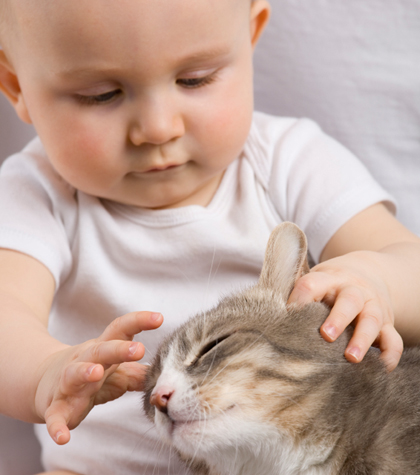
Cats and babies can live in harmony
Photo credit: blisstree.com
The Myth

Think about it for a moment. How could a cat possibly suck the breath out of a baby's lungs? It's physically impossible as any reputable pediatrician or veterinarian will tell you. Not only that, the cat has no motivation to do such a thing, even if it could. While there is a possibility your cat may experience some jealousy when you bring your new baby home, he's unlikely to take it out on the baby in such a violent way.

The Real Risks


More than expressing feelings of jealousy, your cat may feel the need to defend its territory from this little interloper in the crib. The most likely way he's going to do this is by urinating in the crib. It's called "marking," and nearly all cats—both male and female—do it if they feel their turf is being encroached upon. A cat may also urinate someplace besides the litter box if they feel stressed, and bringing a new baby home can certainly be a source of stress for other members of the household, including your pets.

A greater risk is, in fact, suffocation, but it's not intentional. As a cat owner, you know your furry friend likes to cuddle up against you to sleep. Doing this provides both warmth and security. But a cat doesn't know that a baby is vulnerable, and can possibly snuggle up against the baby's face, impeding its breathing. A newborn that can't yet turn its head will have no way defense against a cuddling cat. Remember that this danger is just as prevalent with pillows, or too many blankets or stuffed animals in the crib.

The Better Solutions

You don't have to give your cat away. Behavior issues may occur from time to time. It's all part of owning a pet, and addressing those issues is part of being a responsible pet owner. For some people, the immediate response is to try to give the cat pet meds, like sedatives, to calm the cat and stop the marking behavior. This may be a viable treatment, but it's likely a last resort. Only your vet can determine whether your cat needs any medication. Before you go that route, try a few other solutions.
Properly introducing your cat to the baby is essential
Photo credit: essentialbaby.com.au

Introduce Your Cat to the Baby

When you first get home with the baby, take a few minutes to give your cat some uninterrupted one-on-one time. Play with her, pet her, give her a treat, cuddle her if she tolerates it. Let her know she's important to you.

Your cat will naturally be curious about the newcomer. While you're holding the baby, allow your cat to approach, sniff, and generally check things out. The more you try to keep them apart, the greater lengths your cat will go to in order to get a peek at the weird, noisy thing, including possibly jumping into the crib or onto the changing table, possibly startling or scratching the baby without meaning to. Let her see the baby, and get used to the new scent. Chances are, she'll become bored pretty quickly, and move on to other things.

As your baby grows, remember to keep the kitty safe, too. Babies will be just as curious as cats, and will want to grab and pull at their tails, ears, and fur, or poke their shiny eyes. This can provoke the cat to scratch or bite to defend itself. It's up to you to keep them both safe, and as he grows, teach your child to respect your pet.

Make time to play one-on-one with kitty
Photo credit: rextalkingdog.com
Keep The Cat Out of The Crib

You'll undoubtedly set the crib up well in advance of bringing the baby home. In the meantime, don't let the cat sleep in it. A crib can be a nice hiding place for kitty, but don't let him start thinking it's his territory or you run the risk of him coming in to mark it when he finds a baby in there.

To avoid any mishaps with the baby, like the cat lying too close to the baby's face, keep the nursery door closed when the baby is napping. If you're keeping the crib somewhere that can't be closed off, put up a crib tent to keep the cat from jumping into it.

Make Time For Kitty

A new baby will demand nearly all your attention. But try to make a few minutes every day for your cat. Most cats are very independent, but this doesn't mean they do well being completely ignored. They still need attention and care.

Try not to let your hectic baby-feeding schedule cause you to forget to fill up the cat's food and water dishes. Above all, make sure you're keeping the litter box clean. Letting it get out of hand because you're short on time is a sure way to cause the cat to start urinating in other places, like the sofa or your bed.

With a little planning, some education, and a lot of patience, you can bring your baby home to a loving family that includes your beloved cat.

Jackie is a writer for 1-800-PetMeds and loves to help and support the pet community. You can follow PetMeds on Twitter or connect with PetMeds on Facebook.

Thursday, August 25, 2011

Review: Neko Flies Kittenator

Mad About Pets was lucky enough to try out the Neko Flies Small Kittenator, which is a wand toy for cats. Also included was a Kragonfly attachment which can switch up the Kittenator's furry mouse attachment for a little variety. The Small Kittenator package includes the wand and  realistic furry mouse that you can make scurry along the ground or fly about for your cat to chase.


Neko Flies Small Kittenator
 In my opinion, wand toys are one of the most important types of toys to include in your cat's toy-arsenal. They encourage instinctual stalking and chasing behavior, get your kitty up and active, and also allow you time to interact and bond with your cat. You may have noticed that some kitties like to play with a stationary mouse, throwing it around the room and stalking it as though it were real...yet others will stare at it as if to say "What the heck should I do with this thing?" Wand toys are the perfect solution for kitties that just don't grasp the idea of playing with a traditional mouse toy; I've yet to meet a cat who can resist a scurrying mouse or waving feather that seemingly moves on its own. In our home, we refer to it as "fishing for cats"; just throw out the line, and you're basically guaranteed to snag a cat or two.

They say a picture is worth a thousand words, so I figure that must make a video worth, like, a million or so. I captured on video each of the Mad About Pets test cats to show you just how much they appreciate the Neko Flies Kittenator. (Sorry for the weird black bar on the sides of the videos...I taped these on my phone, which I've never tried before!)

This video features our Birman named Andromeda. She is the bully and the brat of our feline trio, and she is incredibly enthusiastic about her play. Here she shows us how spastic she can get when she plays. Andromeda posed a bit of a challenge when she played with the Kittenator, as she wanted to hold onto the mouse and shred it. This is why cats should always be supervised when playing with wand toys! Well, that and the fact that they may also consume the entire string connecting the toy to the wand...cats and string are a bad combination.

Our next video features Gabe, the elderly gent of the household. He is well-behaved and relaxed most of the time, but when playtime comes, other cats beware--he becomes a kitten again! Here he can be seen doing a very enthusiastic barrel roll. If you look carefully, you will also see that his tail is fluffed up like a bottle brush due to the sheer excitement of "the hunt". The look he gives at about the 5 second mark of the video is positively hilarious--he looks possessed (pull the video up on YouTube and you can see it better). One would never guess he is 11 years old!

Last but certainly not least is Rory. He is our shy and subdued Siamese, who often takes a backseat during group playtime due to the spirited play of his comrades. He does enjoy playing and will sometimes watch from the sidelines, but he doesn't like to get in the middle of things until the others have tired themselves out. I think he enjoys feeling like he's part of the gang, even if he doesn't always take center stage. I always make sure to give him plenty of one-on-one time when the others have zonked out for the day.

What I liked about Neko Flies' wand toys more than some of the others I've tried is the durability. I didn't feel like the rod was going to snap in two or the line was going to break, even when the cats were attempting to yank it out of my hand with all their might. In the past the kitties have successfully torn the toy from the line after just a few vigorous play sessions, but so far no one has managed to detach the mouse or the dragonfly. I also like that the toy at the end of the wand can be switched out. With this feature, if the toy gets beat up or mangy a new one can be bought without having to replace the whole wand. You can also add variety to the toy by changing up the "prey". Some cats may prefer to chase a lighter toy like the dragonfly through the air, while others may prefer stalking a heavier toy on the ground like the mouse. This makes it a very versatile toy for multicat households with different feline personalities.

I would certainly recommend Neko Flies for anyone with a cat (or several). Play is one of the most important things you can do for the well-being of your cat! Check out the full line of Neko Flies wand toys online, or look for them in a store near you!

Wednesday, August 17, 2011

Catapalooza 2011- Friday, Aug. 19th to Saturday, Aug. 20th at DCHS

From the Dane County Humane Society:


Join the cool cats! During the 29-hour adopt-a-thon, you can adopt an adult cat (6 + months) for $29. The special pricing is good at DCHS main shelter, DCHS West and Mounds Satellite Adoption Center, however only the DCHS main shelter is open the entire 29 hours.

Main Shelter: 5132 Voges Road, Madison, WI
West Shelter: 7475 Mineral Point Road #42, Madison WI
Click here for a list of satellite adoption centers

Kick-off August 19th

To kick-off the event, join Patricia McConnell in an informative and entertaining overview of the behavior of the felines in your family August 19 at 7:00pm. We'll explore who cats are, where they came from, and how to send them memos (in cat-speak, of course) with requests for behavioral improvements! DCHS is recommending a $5 donation at the door to attend. Please register ahead of time to secure your spot.

Celebratory Fundraiser August 20th

As our Catapalooza adopt-a-thon comes to an end on Saturday, join us at 7:00 pm at Monte's Grill and Pub in Verona for a celebratory event! Band in a Box will keep the karaoke tunes spinning and there will be great prizes, food and FUN! See you Saturday night!!

Fundraiser Location : Monte's Pub & Grill, 608A West Verona Ave, Verona, WI
Contact : Jan Viney, janviney [at] giveshelter [dot] org

Wednesday, October 13, 2010

BOOK GIVEAWAY: Dewey's Nine Lives

During the day, I work in a small office in county government. My coworkers and I like to talk sometimes about how much more fun the workday would be if we had a resident cat or dog. We're all animal people here in the office, and we enjoy daydreaming about the fun and companionship a resident pet would bring to our office. Though we're likely never to get our wish (unfortunately!), the Spencer Public Library certainly did in the chilly winter of 1988. A small bundle arrived in their metal book-drop...a tiny kitten. This kitten was christened "Dewey", and became the official companion, mascot, and inspiration to patrons of Spencer Public Library. Dewey's Nine Lives is the amazing story of how a tiny kitten brought love and magic to a community that needed him as much as he needed them.


Dewey's Nine Lives: The Legacy of the Small-Town Library Cat Who Inspired Millions is the follow-up to the 2008 #1 bestseller Dewey: The Small-Town Library Cat Who Touched the World. The book sold over 1 million copies in hardcover, spawned three children’s books, and became the basis for a film adaptation that is currently in development, with Meryl Streep in the lead role.

Dewey's Nine Lives, by Vicki Myron and co-writer Bret Witter, contains two new stories about the beloved Dewey, as well as seven other tales of amazing true-life cats of fans who were inspired to share their experiences with Vicki.

Want to win a free copy?

Mad About Pets is giving away to my lucky readers THREE copies of Dewey's Nine Lives. Here's how to snag a copy for yourself:

To enter the giveaway:


All you need to do is leave a comment on this post telling me about how your pet or another special animal has changed your life for the better.

Want some extra entries? Here's how:

5 extra entries:

*Blog about this contest with a link to this post (leave me a comment with a link)

1 extra entry:

*Tweet a link to this giveaway @MadAboutPets
*Follow me on Twitter
*Join my Facebook fan page
*Subscribe to my feed
*Post a link to Mad About Pets on your blog or site
Please leave a separate comment for each additional entry to state you have completed the requirement. I highly suggest that you leave your email address in your comment(s) so that I am able to contact you ASAP if you're a winner. If I cannot contact the winners within 3 days, I will have to draw a new winner.

The giveaway begins today and ends at 11:59 Central Time on October 22, 2010. I'll then be drawing 3 random winners from all the entries. This contest open to residents of the USA and Canada, only.

Thursday, May 27, 2010

Looking to adopt? All adult kittes at DCHS just $1!

In honor of opening the Westside Adoption Center in Madison one year ago, the Dane County Humane Society is offering an awesome deal: all adult cats are just $1 until Sunday, May 29, 2010! If you've been looking to add a feline friend to your family, now is the time to do it. There are plenty of lovely adult kitties waiting for a new home...click here to meet some of the available cats. This special price is available at all DCHS locations.

(Photo left: Stanley, one of the many available cats at the Dane County Humane Society.)

Wednesday, May 19, 2010

SmartCat Ultimate Scratching Post: coming soon!

A lovely kitty enjoying his SmartCat Ultimate Scratching Post

CSN Stores has generously offered to supply Mad About Pets (and of course the Mad About Pets cats!) with a SmartCat Ultimate Scratching Post from one of their online stores! All Modern Pet offers everything from pet sofas to litter box hideaways. The best part is all the products have a modern aesthetic, making them a great addition to any décor.

The Ultimate Scratching Post should be on its way soon, so look forward to an in-depth review in the near future! The Mad About Pets cats will give it a test drive and I’ll let you know what the humans and kitties alike find out. In the meantime, make sure you check out All Modern Pet for a huge selection of unique pet products.